Hotel operations, intelligently orchestrated.

A configurable intelligence layer for hotel groups that connects guest context, live operational signals and hotel rules—automating routine coordination while preserving human judgment.

Connected guest + hotel contextGuest + stay + operations Hotel-aware AIWorks within hotel rules Action layerAutomate or escalate Human controlApprove + override
01
PROBLEMHotel systems work separately while the guest journey crosses all of them
Problem overview

Hotel teams have the tools. The problem is the handoffs between them.

Hotels already use systems for reservations, rooms, messaging, transport, loyalty and service. But a guest journey moves across all of them, so teams repeatedly reconnect the same context by hand. I explored how one shared intelligence layer could coordinate the next move, work within each hotel group's policies, and bring in a person only when judgment is needed.

Signal → actionMove from passive visibility to active coordination.
Hotel rules-awareAutomate inside approved boundaries, escalate outside them.
ContextualCarry guest, property and operational context across workflows.
Human by designProtect staff attention for ambiguity, empathy and judgment.
Where coordination breaks down

The same guest context gets rebuilt again and again.

The information usually exists, but it is spread across systems and teams. Each handoff adds interpretation, follow-up and another chance to lose context.

MY ROLEProduct design lead
I OWNEDExperience strategy · interaction model · AI behavior · visual system · prototypes
DESIGN GOALLess coordination. Clearer decisions. More time for the guest.
01 FRAGMENTATION

Guest context is scattered.

Preferences, arrival details and service history live across different tools.

COSTContext has to be found again.
→
02 REPETITION

Each team interprets the change again.

A simple update becomes repeated reading, checking and forwarding.

COSTThe same update is interpreted more than once.
→
03 ATTENTION

Routine updates compete with real exceptions.

Staff have to scan too much work to find what actually needs judgment.

COSTImportant exceptions are harder to spot.
→
04 COORDINATION

Coordination takes time away from service.

Teams spend time moving information instead of acting on the guest need.

COSTStaff time shifts from service to coordination.
The coordination problem One guest change→Context is split→Teams interpret it again→Staff coordinate manually
A simple example

A delayed flight creates work for five hotel teams.

The guest sees one change in arrival time. The hotel has to update transport, room readiness, welcome timing and several team handoffs.

WHAT CHANGED Flight delayed
→
WHAT THE HOTEL HAS TO CHANGE
Airport pickup Arrival time Room readiness Welcome plan Team coordination
?

THE DESIGN QUESTIONCould the system coordinate these changes before staff have to chase them manually?

02
RESEARCHUnderstand where coordination breaks down and where AI can safely help
Research

I mapped where context gets lost between teams.

01
WHAT I SAW

One stay becomes many disconnected tasks.

Arrival, transport and room prep live across different teams.

→
DESIGN IMPLICATIONCarry guest context across the workflow.
02
WHAT I SAW

Routine updates compete with real exceptions.

When everything looks urgent, nothing feels urgent.

→
DESIGN IMPLICATIONMake the normal quiet. Make exceptions obvious.
03
WHAT I SAW

Automation without reasoning feels risky.

Staff need to know why AI acted—and when to step in.

→
DESIGN IMPLICATIONShow why, confidence and override at the point of decision.
THE DESIGN OPPORTUNITY Keep the context connected as the work moves between teams.
03
SOLUTIONUse AI agents to coordinate routine work while people keep decision authority
Solution model

One shared operating model, coordinated by AI agents.

BACKEND AGENT LAYER
SHAREDGuest + group standards
AIUnderstand this property's situation
LOCALTools + teams + services
Hotel group · shared once
One operating model
Brand standardsGuest contextAgent libraryGlobal guardrails
↓
STAYFLOW INTELLIGENCE AI agents understand → decide → coordinate
↓
MUMBAI
Property context Local staffRooms + inventoryTransport + vendorsLocal hotel rules
HYDERABAD
Property context Local staffRooms + inventoryTransport + vendorsLocal hotel rules
UDAIPUR NEW
Property context Local staffRooms + inventoryAirport + vehiclesLocal hotel rules
SAME INTELLIGENCE · DIFFERENT LOCAL CONTEXT
01Shared by the group

Agents · guest context · brand standards · global policies

02Understood locally

Property · staff · rooms · airport · vehicles · vendors · availability

03Coordinated by AI agents

Handle routine work · recommend next actions · escalate exceptions to people

Design principle: AI agents coordinate the routine work behind the scenes; staff use one consistent experience and stay in control of exceptions.
Experience principles

Three design principles guided the experience.

01 CONTEXT

Keep guest context with the work.

Agents carry the same guest context as work moves between teams.

One stay context → every relevant surface
02 ATTENTION

Keep routine work quiet.

Agents handle routine coordination quietly. Exceptions get attention.

Routine → compressed · Exception → amplified
03 TRUST

Explain why an exception needs attention.

Show what changed, what the agents handled and why a person is needed.

What changed → AI action → staff decision
LIVE SIGNALSomething changes
→
AI + AGENTSCarry context · check hotel rules · coordinate tools
→
UX OUTPUTDone quietly or surfaced clearly

Automate the predictable. Design for the exception. Keep hospitality human.

System flow

How AI agents coordinate a change without taking control away from staff.

Agents connect the signal, guest context, hotel rules and tools. Staff see the result—and step in only when judgment is required.

01NOTICE

Something changed.

Say what changed.

→
02CONNECT

Agents connect the context.

Bring the guest, property and operational context together.

→
03CHECK

Agents check the boundary.

Apply hotel rules, permissions and confidence.

→
04ACT

Agents act when safe. People decide when needed.

Complete routine work—or surface one clear decision.

WHAT HAPPENS BEHIND THE EXPERIENCE
Signal→AI connects the guest + hotel context→Agent checks hotel rules + connected tools→Action / escalation
THE UX PROOF

Routine work stays quiet. Decisions are easy to spot.

Quiet when handled. Clear when a person is needed.

Today · The Oberoi Hyderabad

What needs attention

4 live signals
VIP arrival timing changed

Flight AI 127 is delayed. Transfer and welcome timing have been updated automatically.

No action needed
Context carried forwardReturning guest · suite preference · prior recovery note
TransferRe-timed +62 min
Room prepWindow aligned
Handled quietlyAI agents coordinate the routine work; staff see the outcome, not the machinery behind it.
Exception · arrival workflow

Transfer requires judgment

High guest impact
Original chauffeur unavailable

A replacement can be confirmed, but cost is above the approved automatic threshold.

Approval required
Why this surfaced₹ threshold exceeded · VIP arrival · 41 min to pickup
RecommendedConfirm alternate
OwnerDuty manager
2. Exceptions surface with evidence and a clear reason a person is needed.Human attention is requested because the decision is no longer safely inside hotel rules—not because the AI failed.
Guest context

Arjun Mehta

Returning VIP
What matters this stayQuiet suite · late breakfast · airport pickup · prefers minimal check-in friction
Prior stay memoryService recovery completed after evening room-service delay.
Context is portable across workflows

Operations and the assistant use the same guest context without making staff reconstruct it manually.

Context follows the guestThe goal is not a richer CRM profile. It is context that changes how downstream work behaves.
Supply risk

Premium linen buffer

Guest impact linked
Vendor reliability is now affecting room readiness

Three missed delivery windows create a projected premium-room constraint.

Suggested containmentProtected trial order with alternate vendor
Coverage60 premium sets
RiskReduced
Operations connect to serviceOperational signals are framed by guest impact.
Key design decisions

Four design decisions shaped the day-to-day experience.

Each decision connects directly to something you can see in the prototype.

01 AI WHERE THE WORK HAPPENS

Help staff without making them open another tool.

  • Guest details stay inside the guest view.
  • Operational updates stay inside Operations.
  • AI helps in context instead of becoming a separate destination.
02 FOCUS ON WHAT NEEDS ATTENTION

Don't make every update feel urgent.

  • Completed work becomes a simple status.
  • Problems and delays get more visual weight.
  • Staff can quickly see where they need to step in.
03 MAKE AI EASY TO TRUST

Show what AI changed—and let staff stay in control.

  • Explain what happened in simple language.
  • Show what the system already updated.
  • Ask for a decision only when human judgment is needed.
04 KEEP THE GUEST STORY TOGETHER

Don't make staff search for the same context twice.

  • Preferences, arrival and service needs travel together.
  • Teams see the context relevant to their task.
  • The guest experience stays connected across departments.
Design system

A shared product system that can adapt to each hotel brand.

The system separates product behavior from brand expression. Workflow, hierarchy, accessibility and AI states stay stable; hotel groups can change typography, color, density, radius, surfaces and emphasis without rebuilding the product.

01 · PRODUCT FOUNDATION

What never changes

AccessibilityTask hierarchyAI statesInteraction logicData density
02 · BRAND LAYER

What each hotel group owns

Color rolesTypographyRadiusSurface treatmentIllustration
03 · PROPERTY CONTEXT

What changes locally

ServicesPoliciesInventoryTeamsCapabilities
Component contract

Brand styling can change without changing the workflow.

Meaning stays consistent across every theme.
Color, type and surfaces can change.

SEMANTIC TOKENstatus.warning
→
COMPONENT ROLENeeds review
→
BRAND EXPRESSIONColor · type · surface
Plug-and-play theming

Change the brand without rebuilding the workflow.

Switch the hotel brand. Type, surfaces, shape and components adapt. The workflow stays the same.

TYPEEditorial serif + clean UI
SURFACEWarm ivory
SHAPESoft luxury
VOICEQuiet, personal
A
AURORA RETREATSGuest Operations
OverviewArrivalsGuests
ARRIVAL INTELLIGENCE

Today's arrivals

ARRIVAL EXCEPTIONGuest arrival shifted
Needs review
AM
Alex MorganDeluxe King · Arriving today
AI
Flight AI 471 delayed by 38 minPickup moved to 14:50 · Driver notified · Room plan updated
AGENT REASONING 3 connected actions completed inside property rules.
Switch the hotel group above. The entire interface language changes; the operational contract does not.
Principles for AI-native operations

Define the rules that guide AI actions.

1. Context before generation

The system should understand the guest, property and current operational state before proposing anything.

2. Autonomy must be bounded

Confidence is not enough. Actions also need permission, hotel rules, cost and service-risk checks.

3. Exceptions deserve narrative

When a person is interrupted, show the trigger, downstream impact, recommendation and decision needed.

4. Preserve agency

Automation should be inspectable, reversible where possible and clearly owned.

5. Measure avoided work

Success is not chat usage. It is fewer manual handoffs, faster exception resolution and less coordination overhead.

6. Hospitality remains human

Use AI to protect staff attention so people can spend it on empathy, judgment and memorable service.

04
STORYFollow the design through a real hotel scenario
A real hotel scenario

Follow one delayed arrival through the experience.

01
Arrival time changes

A flight signal shows the guest is now expected 62 minutes later.

SIGNAL
02
Stay context is ready

Returning VIP · airport transfer booked · suite readiness known.

CONTEXT
03
AI agents coordinate the response

Pickup timing, room readiness and the welcome plan move together across the relevant teams and tools.

COORDINATE
04
Agents handle routine changes quietly

No extra cost, capacity issue or hotel-rule conflict—so the agents can proceed within their approved boundaries.

AUTOMATE
05
A person stays in the loop for judgment

If a driver is unavailable, cost crosses a limit or service risk rises, the agents stop and ask for a decision.

HUMAN
What the staff experience

Staff see what changed, what was handled and what still needs a decision.

This scenario became the test for the design: can AI agents coordinate the routine work across teams while making the few moments that need human judgment easy to see?

handled automatically needs judgment
THE EXPERIENCE SHOULD FEEL LIKE “The hotel is ready.” Not: “five agents completed five tasks.”
RESEARCH → DESIGN RESPONSE

Operational pattern: pre-arrival email captures valuable intent, but free-text replies still create interpretation and handoff work. StayFlow response: keep the familiar pre-arrival touchpoint, but make the response structured and actionable.

A second moment in the journey

Turn a guest preference into work the hotel can act on.

Pre-arrival communication already captures valuable guest intent. StayFlow turns that intent into structured operational context that teams and agents can act on immediately.

BEFORE

Email becomes the workflow

The guest writes a reply. Staff turn that reply into operational work.
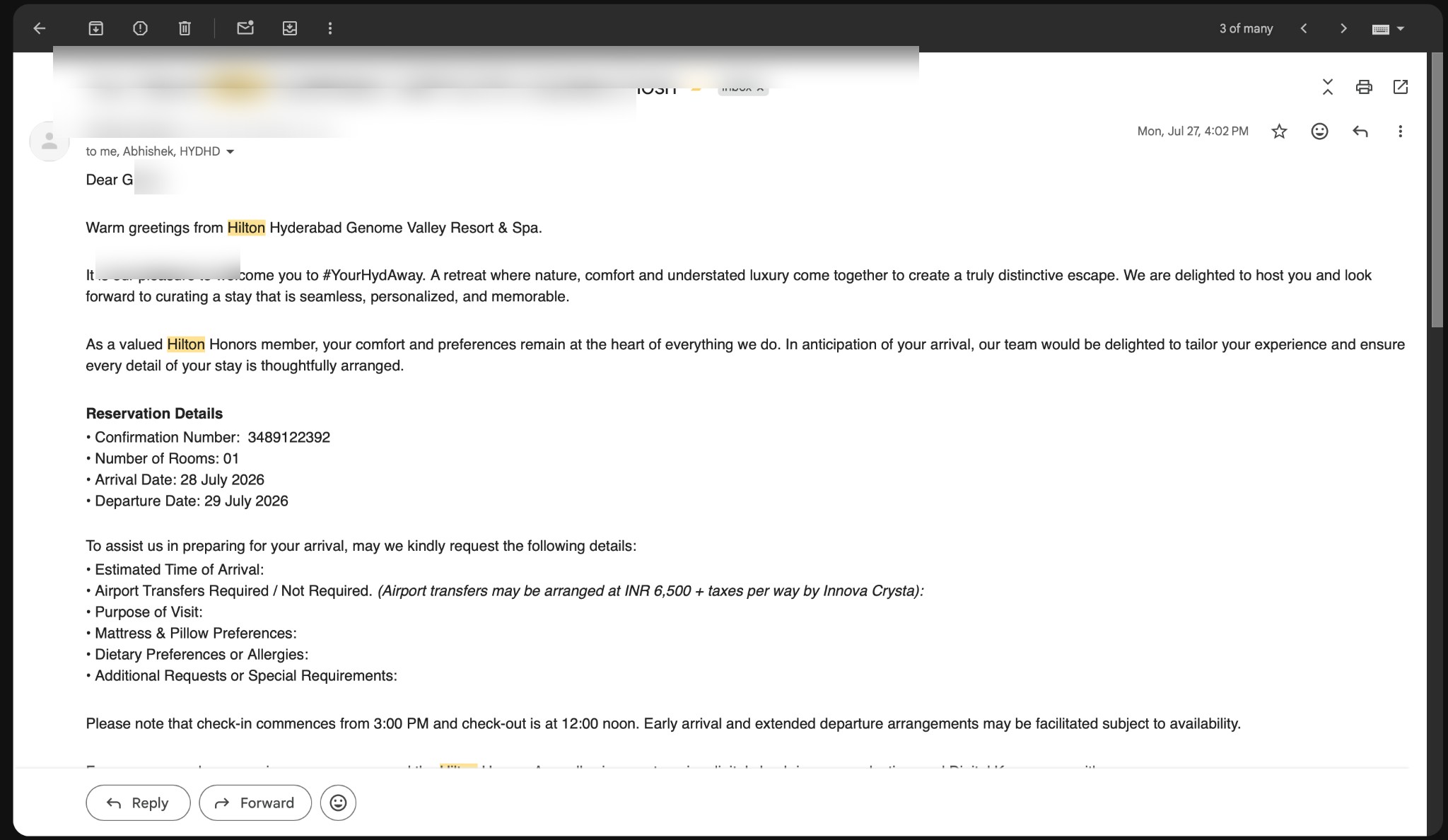
Guest types details → Staff interpret → Teams are briefed
AFTER

Intent arrives ready to use

Most answers are taps. The agent receives structured context instead of another email to decode.
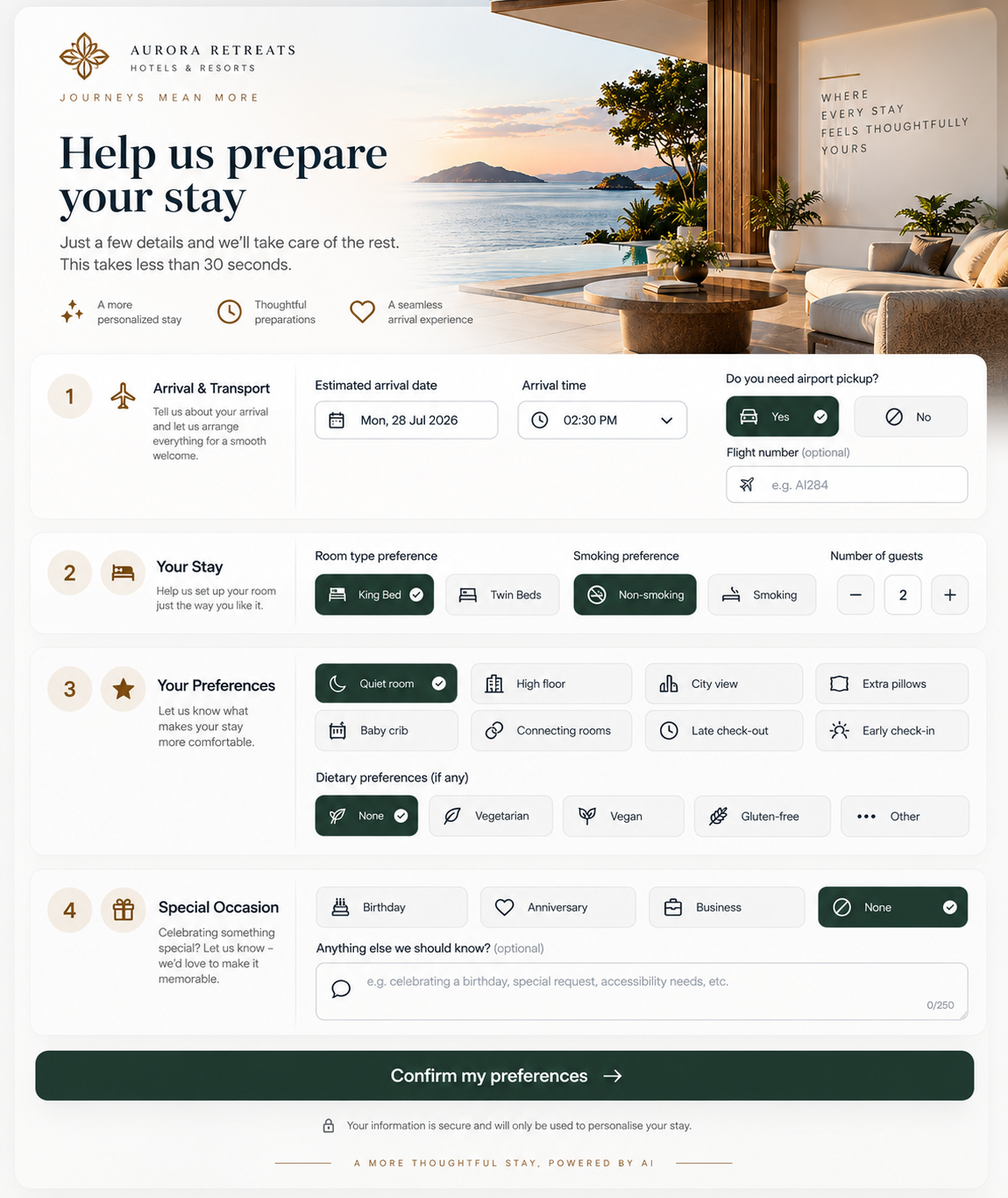
Structured guest preference quick form
Guest confirms → Context is structured → Work is routed
01 Less effort for the guest

Tap the preference instead of composing a long reply.

02 No translation step

The response is already structured for the operating system.

03 One response, many actions

The same intent can trigger transport, room prep and concierge work.

How the request moves through the system

The response becomes usable context for the agents and teams that need it.

The Mother Agent checks reservation context and hotel rules, then coordinates specialist agents for transport, room preparation and concierge work. Staff are brought in when a decision crosses an approved boundary.

GUEST INTENT Pickup · King bed · Quiet room · Anniversary
→
MOTHER AGENT Understand · check · coordinate
→
Transport Room prep Housekeeping Concierge
Personal-stay examples are anonymized; hotel and guest details are obscured.
FROM STORY TO EXPERIENCE

Experience the workflow

See how AI agents coordinate routine work behind the scenes, surface the moments that need human judgment, and stay governed through the administrator experience.

Agents coordinate the work→People stay in control→Admins govern the system
↗
WORKING PROTOTYPESLet’s experience the design solution
Front-facing experience

See the property experience in action.

Start with the hotel team’s view. See AI agents carry guest context, coordinate routine tasks across teams and surface only the exceptions that need a person.

PUT ON THE HAT
Property Operations LeadKeep arrivals moving. Step in only when needed.
Try this Open a guest → check an exception → move across Operations and Management
Demo property implementation · 1920 × 1080 product viewport

Tip: this demo instance retains its in-product brand, but the case study describes the underlying platform as configurable for any hotel group. All left-navigation tabs are now routed internally inside the embedded demo.

Admin-facing experience

Now see how the same system is governed.

Switch to the administrator’s view to see how AI agents are monitored, tested, bounded and approved before they coordinate work across properties.

Primary persona

AI Operations Admin

One role, four hats depending on the decision at hand.

01Portfolio operatorIs the agent fleet healthy?
02Property enablerIs this location ready?
03AI governorCan I trust this decision?
04Service standards ownerWhere must humans stay in control?
↗
Scale a proven agentReuse one central agent at a newly opened property.
◎
Detect readinessDiscover local airport, systems, chauffeurs, vehicles and hotel rules.
✓
Test before trustRun a scenario and inspect reasoning + confidence.
◇
Govern autonomyApprove deployment while preserving thresholds and escalation.
Central agent→ Local context→ Capability check→ Safe test→ Human approval→ Deploy
PUT ON THE HAT
AI Operations AdminScale agents while keeping hotel standards and local control visible.
Try this Inspect a metric → deploy the Airport Transfer Agent → run the test → approve it
Admin working prototype

Monitor, test and approve before deployment.

The prototype focuses on one reusable Airport Transfer Agent moving safely into a new property.

Central AI Operations · working admin prototype
Recommended path: Overview → Airport Transfer Agent → Deploy to new property → Test → Approve → Deploy. All other navigation is intentionally secondary.
05
OUTCOMELet AI agents absorb coordination work while people stay focused on service
Outcome

AI agents handle more coordination. People keep the moments that need judgment.

The goal isn't to automate hospitality. It is to let AI agents carry the invisible coordination work while staff stay in control and spend more attention on the guest.

FOR THE HOTEL

Give teams time back for hospitality.

01Fewer manual handoffs

AI agents carry connected guest + hotel context between workflows instead of asking staff to copy it between teams.

02Human attention goes to exceptions

Agents handle routine coordination and bring staff in when a decision needs judgment.

03One agent model can scale

Reusable agents work across properties while local hotel rules, permissions and capabilities stay local.

+
FOR THE GUEST

Make the stay feel remembered, not processed.

01Say it once

Preferences become usable context instead of another request to repeat later.

02Less friction, more anticipation

Pickup, room preparation and service can adjust before the guest has to ask.

03Human when it matters

AI agents handle coordination so staff can spend their attention on empathy, judgment and the guest experience.

74%

of travelers surveyed were interested in hotels using AI to better tailor services and offers.

Oracle Hospitality consumer research
76%

of hoteliers in a cited hospitality survey agreed personalization boosts reputation and repeat business.

Deloitte / Mews
2.5×

more value placed on personalized hotel service by Gen Z travelers than baby boomers in McKinsey research.

McKinsey Travel Loyalty Survey
THE RESULT

Less work behind the scenes.
More attention for the guest.

StayFlow keeps the hotel coordinated behind the scenes—so teams spend less time managing handoffs and more time keeping every guest happy, prepared for and cared for.

Less operational effort → More time for the guest → Better stays, consistently
StayFlow Intelligence Run the hotel with ease. Keep hospitality personal.